My father died earlier this year and I inherited a huge pile of Edwardian postcards which had been handed down the generations. Most of the cards were published by Raphael Tuck and Sons. I decided to find out a bit more about the company.
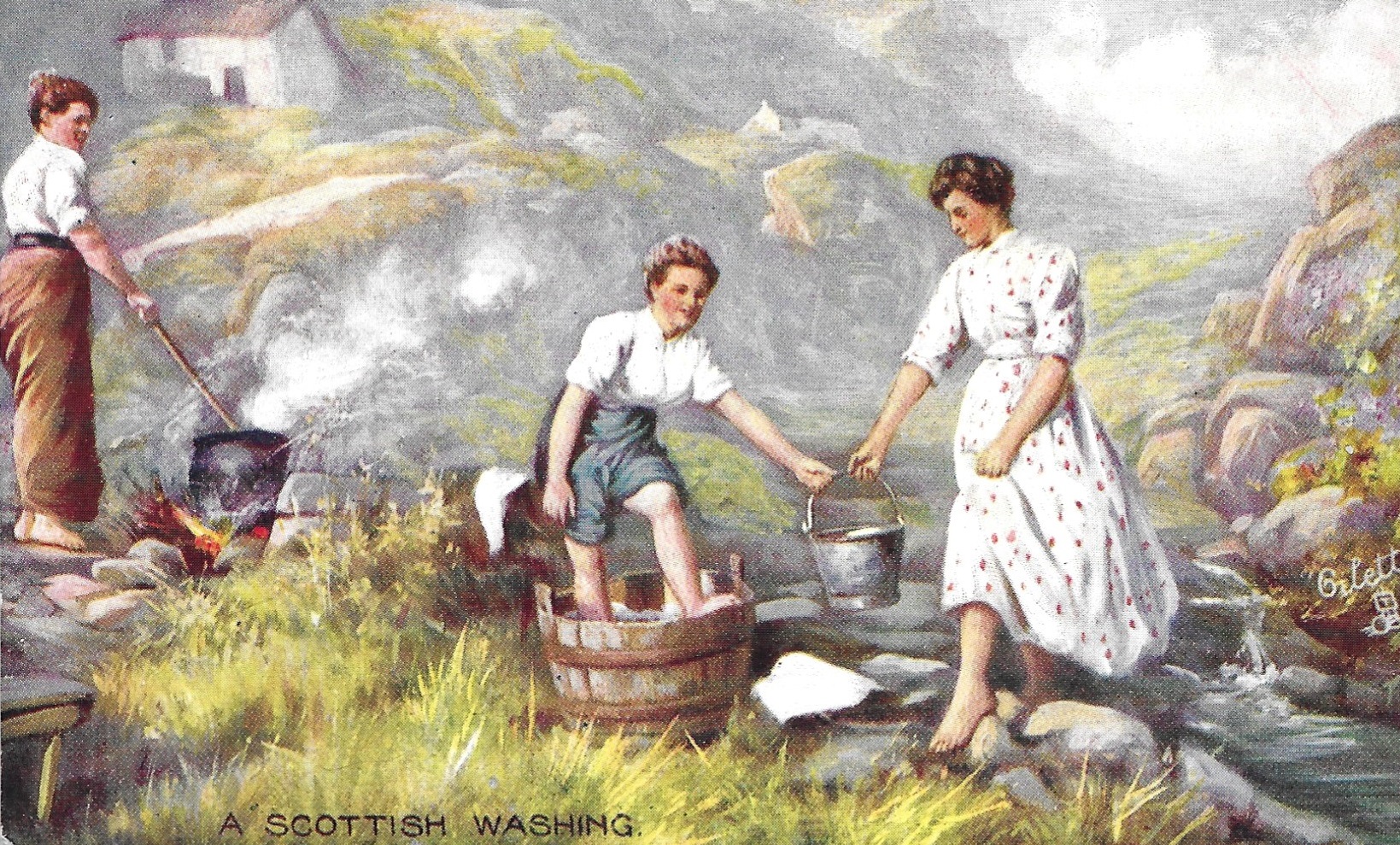
Raphael Tuck was a Prussian immigrant who, together with his wife, started up a business in London in 1866 publishing and selling pictures and greeting cards. the business grew steadily over the years but the master stroke came when they introduced coloured art postcards into their catalogue. At that time the format of postcards was strictly controlled by the Universal Postal Union and only allowed a brief message on the picture side which limited the size of the picture. After lengthy negotiations, Tuck was able to convince the British Postmaster General to accept both the name and address coupled with the message on one side and a full size picture on the other. This revolutionary agreement in 1898, opened up great opportunities for the company to sell postcards featuring the artwork of many contemporary artists. They created a hugely successful collectibles market by selling themed cards in packs of 6. As well as more conventional views of beauty spots and iconic buildings across the world they developed cards featuring occupational and military subjects. For we genealogists, these are of much more interest. Their Scottish subjects for example included ‘A Scottish Washing’ and ‘Scottish Fisher Life’ in their Oilette range. The range was introduced in 1903 and designed to look like oil paintings. Two of the Scottish Washing theme are illustrated here and provide an interesting impression about how a wash day might have been conducted in different settings.
It makes an interesting contrast to the rather straight-laced posed family photographs which dominated the later Victorian period.
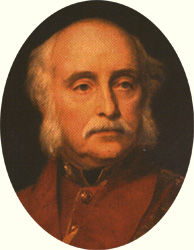
General Sir Charles William Pasley (1780 – 1861) was a distinguished British soldier and military engineer. He had a brilliant mind and his writings are generally considered to have influenced the development of the British Empire. He was fundamental in setting up the Royal Engineers regiment.
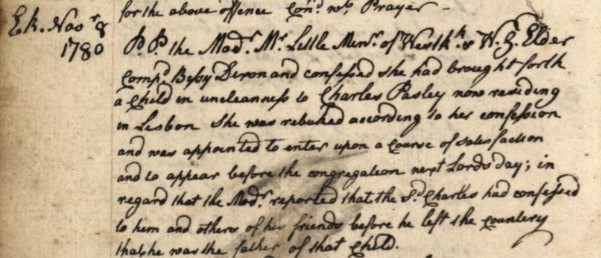
He was born in Eskdalemuir in Dumfriesshire on 8th September 1780. However, you’ll not find the birth of a Charles Pasley if you look in the Old Parish Registers. He was born illegitimate as Charles Dixon with just his mother Bessy (or Betty) Dixon listed. It is the minutes of Eskdalemuir Kirk Session which tells us the real story.
“Compeared Bessy Dixon and confessed she had brought forth a child in uncleanness to Charles Pasley now residing in Lisbon. She was rebuked according to her confession and was appointed to enter upon a course of satisfaction and to appear before the congregation next Lord’s day; in regard that the Moderator reported that the said Charles had confessed to him and others of his friends before he left the country that he was the father of that child.”
The Kirk Session record shows that both mother and father have separately confessed their guilt to the minister. His father Charles Pasley was a merchant in Lisbon with a family link to Craig in neighbouring Westerkirk parish. His uncle was Admiral Sir Thomas Pasley RN who served with distinction in a number of 18th century naval campaigns.
This is one of the many insights that only the minutes of the Kirk Session can give us about Scottish historical figures. These Kirk Session minutes are freely available at scotlandspeople.gov.uk. You’ll also find a list elsewhere on this site (available for a small charge) which indexes all illegitimate births, irregular marriages and antenuptial fornications which were exposed by Eskdalemuir kirk session between 1703 and 1823.
Today we tend to think of mainly rural areas like the Scottish Borders as areas that have suffered from depopulation as people have moved out to find suitable employment. It’s not somewhere that you’d choose to find lots of skilled jobs and good prospects. However, one hundred and fifty years ago, things were very different. Galashiels and Hawick were the prime locations for what was termed as ‘Scotch tweed’ not just in Scotland but in the whole of Britain. As the major manufacturing centres in the country, the opportunities available in the scores of working woollen mills attracted skilled workers from all over the country.
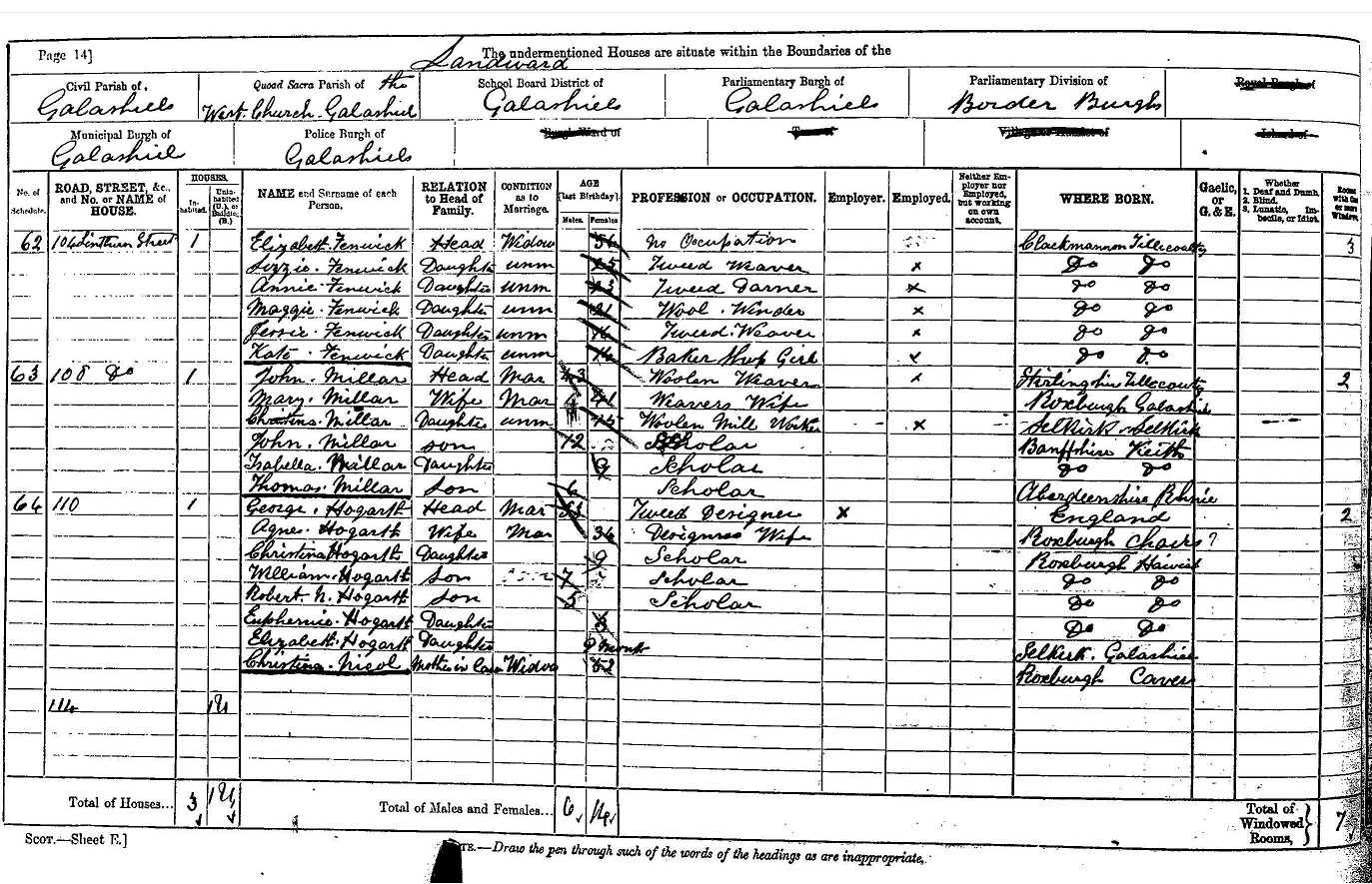
If you take a look at any census for Galashiels and Hawick in the later part of the 19th century, what you’ll find is a significant number of residents were born in Clackmannanshire. The towns of Alva,Tillicoultry and Alloa there also had woollen mills and therefore a skilled workforce who were attracted to the Borders.
The image above is of a fairly typical page in the 1891 Census for Galashiels. Three families are listed on the page and They all have family members working in the tweed/woollen industry. The first family the Fenwicks were all born in Tillicoultry and the male head of the second household John Millar, a woollen weaver, was also born there. It’s likely that a large number of Hawick and Galashiels residents today do have at least some of their family roots in the Hillfoot towns of Clackmannanshire.
In the 18th and 19th centuries, the largest single landowner in Dumfriesshire and the Scottish Borders was (and still is) the Duke of Buccleuch. Many ordinary people made their living on the Buccleuch estates – perhaps directly employed to serve in the castles and gardens, to provide labour for estate improvements , or to farm the land as tenants or sub-tenants of the Duke. It is therefore natural to consider what evidence might be left of such an ancestor in the archives of the estates.
Estates as large as Buccleuch generated a substantial amount of paperwork in routine administration on a day to day basis. Indeed the burden of administration was often contracted out to a range of parties including chamberlains and solicitors. As a result, there is very much a mixed picture of records across the estates – some have been kept meticulously and survived over hundreds of years. Others are sporadic and incomplete.
For those in the direct employ of the estate, the records are patchy. Some records of wages for named individuals for certain periods do survive but many have been lost. There are also some records of piece payments for specific work undertaken by contractors like quarrying or forestry.
The area which has perhaps been best preserved are the rental rolls for the farm tenancies which cover a period from around 1630 through to the 20th century. Many of these rolls are now in the care of the National Records of Scotland in a collection known as the ‘Buccleuch Muniments’. These include the estates of Dalkeith, Melrose, Eckford, Ettrick Forest and Kirkurd, Hassendean and Hawick, Teviotdalehead, Eskdale, Ewesdale, Westerkirk, Eskdalemuir, Liddesdale and Canonbie.
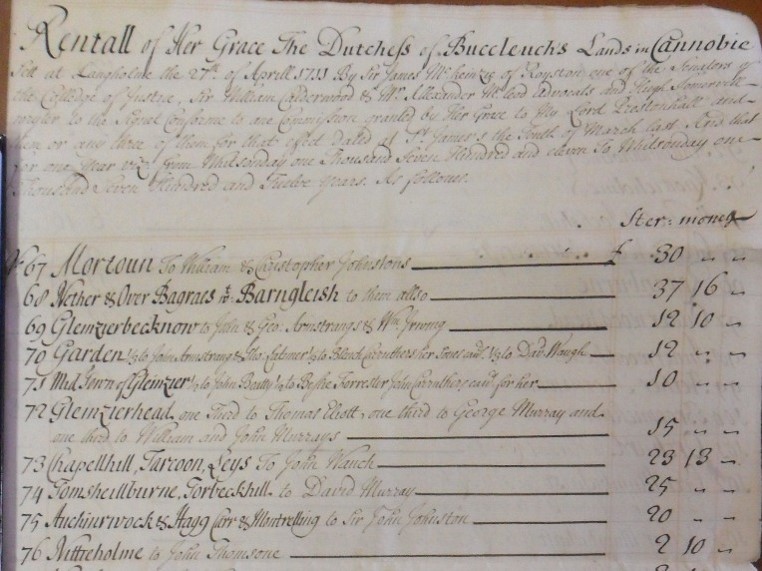
A rental document details the name of tenants and the amount which they were due to pay on an annual basis. On the face of it, that may not seem to be of much value to a family historian. However, the chamberlain who was responsible for drawing up the rental document would often add little snippets of helpful family information e.g. ‘George Armstrang, son to the old tenant’ can be very useful information when we have the possibility of consulting an earlier rental to find a ‘Robert Armstrang’ as the tenant at that particular farm several years before. If we read the tenants as ‘Jean Thomson and her son Robert Elliot’ then we can deduce that Jean Thomson’s husband was a Mr Elliot who was the former tenant and has now died (women are always given their maiden name in these rental documents) and Jean and Robert are now joint tenants. Brothers and uncles are also often mentioned too. There was a strong tradition of keeping tenancies in a family wherever possible in the Buccleuch Estates. I know this as my own ancestors were tenants at a single Buccleuch property for over 250 years.
Part of a 1711 rental record
In normal times, records held by the National Records of Scotland can be consulted if you can visit Register House in Edinburgh. But with Register House having been closed since March 2020, these are definitely not normal times. I have therefore made transcriptions of some Buccleuch rental rolls that I hold available for download on this website. These cover just two of the estates – Canonbie and Liddesdale. Some are free of charge and there is a small charge for others. I believe however that they will be of considerable value for people who have farming ancestors from this area. Years available at present are 1630, 1766-67 and 1814-15 for both Liddesdale and Canonbie and also 1792-93 for Canonbie. The later rolls in particular often feature not just main tenants but sub-tenants and cottars too with perhaps just a house and a very small patch of land for themselves. Further Canonbie rolls for 1683 and 1701 have just been added to the collection.
Records pertaining to the Queensberry Estate (surrounding Drumlanrig Castle in Dumfriesshire) remain with the Duke and so tracing ancestors on this estate is not as simple. However, I’m excited to announce that I’ll be able to offer some transcripted rentals for Queensberry Estate very soon.
2020 has been a tough year for everyone and that includes those researching their family history. At last we have the hope of vaccinating the whole population within the next year so perhaps better times lie ahead. For many though, archives and family history centres have been closed for months and all those plans we had have had to take our research further have had to be put on ice.
Here at Relatively Scottish this year we’ve done our best to make some of our resources available more widely to help those of you with an interest in Liddesdale and Canonbie in particular. These are normally only available to those who visit archives like the National Records of Scotland in Edinburgh (closed since March 2020) in person. Estate records and Kirk Session records can be a great resource to use for those who have exhausted more conventional resources like Old Parish Registers and Monumental Inscriptions.
In addition to the 15 documents that we currently have online, we’ve just added two more. We’ve now made available a full transcription of the Canonbie parish rental for the year 1792-1793 based on the records of the Buccleuch Estates. This is possibly the most detailed Buccleuch rental document with everything from the largest farms down to the most basic cottar’s cottage included.
AND we’re delighted to include a very early Communion roll for Canonbie covering the years 1749-1760 free of charge. The communion roll is one of the gems contained within the kirk session records. There are many communion rolls within kirk session records but most date from no earlier than the mid-19th century. So a mid-18th century roll is rather special !
We’ve heard that Scotlandspeople will be making the kirk session records searchable free of charge online sometime during 2021 which is exciting news. However at this stage there are no plans for Scotlandspeople to provide any indexing which can mean that searches can potentially take a long time (many of the kirk session minutes are very wordy and not always written in the best handwriting). All of our index documents based on kirk session minutes (irregular marriages, illegitimate births etc) include page references to the the original records which will allow users to access the full original documentation easily and quickly once the kirk session records are made available online.
And look out for a further index document on illegitimate births to appear here shortly. It will be for the adjacent Dumfriesshire parish of Kirkpatrick-Fleming. There are over 400 illegitimate births for Bells, Irvings and Carruthers to name but a few !
Last time I talked about the value of Kirk Session records and how they can help to fill the gaps in the information provided by more conventional resources that we know like Old Parish Registers and Monumental Inscriptions. One of the drawbacks of the Kirk Session records is that they require computer access to the imaging network of the National Records of Scotland either in Edinburgh or in one of the satellite hubs in heritage centres elsewhere in Scotland. With these centres having now been closed for many months, we can see the deficiencies in current provision very plainly. And don’t even mention access for those further afield outside of Scotland !
However, I’m delighted to announce that I’ve completed indexing of Canonbie kirk session records and am making full indexes available on this site. Three indexes will be available – one covers 975 illegitimate births between 1708 and 1855 and the name of the father is almost always included. The kirk session records show that most of the named fathers do acknowlege their ‘guilt’ to the church. A few do initially dispute the fact that they were in fact the father but after a de facto trial process which the kirk session invoked, most do in fact finally agree (and were thus liable to pay some maintenance to the mother).
There were around 250 so-called ‘irregular marriages’ – marriages which were legal in the eyes of the law but frowned on by the church. Canonbie was in an ideal location for irregular marriages to happen. In the early 18th century, runaway couples from Canonbie just had to cross the border into England and there were clergymen who could marry them there in front of witnesses without all the palaver of a Church wedding. However, with the introduction of Hardwicke’s Act of 1753 in England, it was no longer possible to get married there without residence requirements and banns being read. Very quickly, Scottish marriage law suddenly became exceptional in not requiring residence and nor did it need a clergyman to perform the service. A whole industry came to be set up in the neighbouring parish of Gretna targeted at eloping couples from England. However, it was also very simple for couples from Canonbie to find a suitable marriage ‘celebrant’ there and continue to defy the kirk. Time and time again we find reference to Gretna irregular marriages within Canonbie Kirk Session records.
The third classification singled out for rebuke and fine by the kirk session was ‘ante-nuptial fornication’. This was encountered when a couple conceived a child out of wedlock but then got married, normally before the child was born. Over 250 instances of this occurs in the records between 1708 and 1855. In reality, there would have been many more but records don’t survive for that entire period – there are some gaps. A particular value of these records is where they indicate a marriage prior to 1768. There are no OPR marriage records for Canonbie parish prior to 1768.
Along with the Kirk Session records, a number of indexes of farm rental records for Canonbie are also being made available covering different rental years between 1630 (the earliest available Buccleuch rental document) and 1815.
Download documents are variously available for free, or for a small charge of £5 or £10. This will help support further transcriptions for this and other parishes. Visit the Canonbie Download page here
All too often, searching in the Old Parish Registers (OPRs) fails to produce the proof that we’re looking for in terms of a birth or a marriage in the late 18th or early 19th centuries. Now it could be that the ancestors concerned had seceded from the Established Church of Scotland and their records therefore do not feature in the OPRs or the records have not survived or were never properly recorded in the first place. But, particularly for births and marriages in Dumfriesshire and other parts of south Scotland, the Kirk Session records provide an alternative gold mine for genealogists.
The Kirk Session could be regarded as the management committee for the parish and one of their primary objectives was to pay close attention the the morals of their congregation. While they did record and discipline behaviours like drunkenness and failing to observe the Sabbath properly, they were generally much more interested in sexual transgressions. Normally, all such activity was recorded in some detail for which we genealogists are eternally grateful.
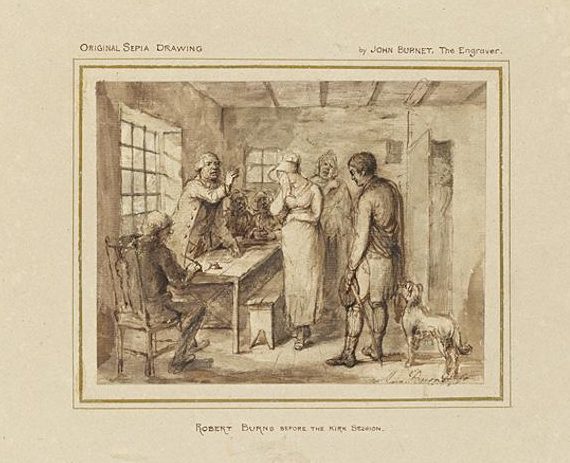
Robert Burns appearing before the Kirk Session
One of the basic sins was an irregular marriage i.e. a couple could legally get married outside the church – particularly common for parishes close to the English border where they were able to nip across and get married by either English clergy or lay-men. These marriages were legal in the eyes of the law but the Church did not approve and would discipline any participants. This disciplinary process is fully recorded in the kirk session minutes. These marriages do not generally appear in the OPRs.
The Elders (members of the Kirk Session) would typically keep their eyes open for any single women in the parish who appeared to be pregnant and any such women would be referred to the Session. They would be required to come before a meeting of the Session and confirm their pregnancy and name the father, and where the activity took place. The suspected father would then be summoned to appear also and in most cases, accepted that they were the father. Both parties would then be subject to a disciplinary process requiring them to be rebuked in front of the whole congregation perhaps several Sundays in a row depending on the particular circumstances. In some cases they could pay an additional fine in order to avoid the repetitive and presumably embarrassing process of rebuke.
In rural Dumfriesshire where there was a large population of young farmworkers, both male and female, living away from home, there were a large number of these cases which means that the kirk session records can often be very extensive. Minutes for Canonbie parish for example extend to over 1000 pages even with some dates missing. In some cases, the expectant couple would choose to get married by the church but often this didn’t happen. The church itself was particularly concerned that the father would accept responsibility for the child which meant that he would be expected to provide something for the child financially. This meant that the parish would not be responsible for supporting the child.
Although there was talk of Kirk Session records being made available via Scotlandspeople, this is not the case today and there are no immediate plans that I’m aware of to do so. Consultation therefore of the Kirk Session records (which have been fully imaged) requires a visit to the National Records of Scotland in Edinburgh or one of the satellite access points elsewhere in Scotland. The online NRS catalogue (https://catalogue.nrscotland.gov.uk/nrsonlinecatalogue/welcome.aspx) can be used to check the kirk session minutes coverage for each parish. Enter ‘CH2’ in the reference field when searching. Relatively Scottish can search kirk session records for you at the NRS – please get in touch to learn more.
Did you know that First Minister Nicola Sturgeon’s ancestors were Ulster Scots? Scots who had moved to Ulster and may have been there for as long as two hundred years before coming back to settle on Ayrshire soil around 1847. Robert Sturgeon was the son of weaver William Sturgeon and his wife Mary Stevenson who lived in County Down. It seems highly likely that it was the famine caused by the potato blight that caused Robert Sturgeon and his wife Mary Cochrane and their family of 5 or 6 to make the journey to Scotland to seek a better life. Robert found work as an agricultural labourer in Dailly in South Ayrshire and the family remained in Ayrshire thereafter.
But what of the origins of the family ? Why did they move to Ulster in the first place ? The Sturgeon name has its origins firmly in and around Dumfries and the eastern part of the Stewartry. And Sturgeons do crop up associated with a number of historical events associated with the area..
In an epic power struggle during the regency period when
James VI was just a boy in 1585, John Maxwell, the Earl of Morton, attacked
Stirling Castle with a large number of his tenants from Dumfriesshire. Among
them were 15 Sturgeons.
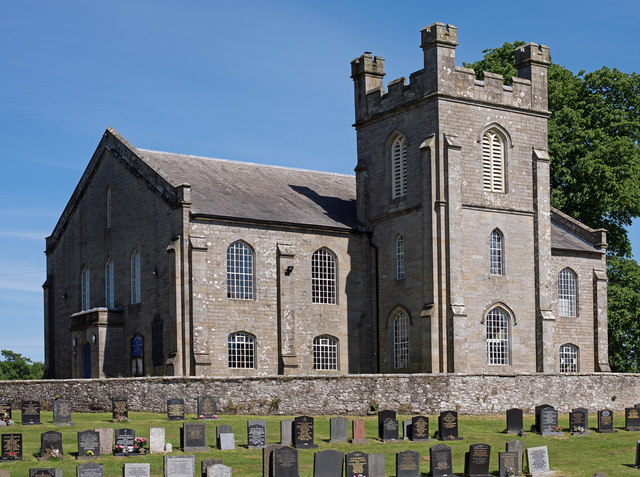
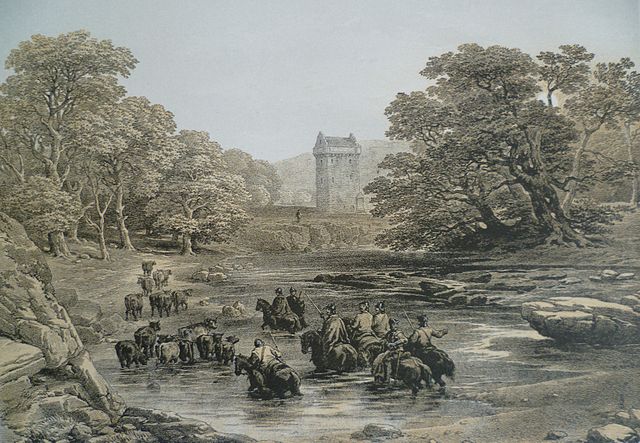
Sturgeons appeared on both sides of the Covenanting argument. In 1644, Sir John Sturgeon of Torrorie (near Kirkbean in Galloway pictured above) was tried in Edinburgh with a number of other lairds for his Royalist sympathies. Some of his co-accused ended up losing their heads but Sir John seems to have been a little more fortunate. Forty years later, when Covenanters were being hunted high and low during the ‘Killing Times’ , a William Sturgeon of Barncrosh (near Ringford in Galloway) was accused of conversing with Covenanting fugitives.
It’s not inconceivable that Nicola Sturgeon’s ancestors may have moved to Ulster to enjoy greater religious freedom during the 1680s when the South West of Scotland was a dangerous place for Covenanters. Perhaps we shall never know.
I’ve often seen it suggested that what with the wholesale hanging of reivers in the years following 1605 and the considerable exodus of reiver names to the Ulster Plantation after 1609, that areas like Liddesdale and the Debateable Lands of Canonbie were radically changed in the years that followed. And indeed most of the killing, plundering, blackmail and moonlight riding did stop. But what if we were able to see what families were living there in place of the reivers some twenty years later ?
By 1621, the Earl of Buccleuch had acquired pretty much all of Canonbie and much of Liddesdale. And thanks to the historical rental records of the Buccleuch estates we can see exactly who was tenanting all their farms in Liddesdale and Canonbie as early as 1630. I have transcribed the information as best as I can and the results may surprise you. The rental lists are shown in the two links below.
In Liddesdale you can see that it’s pretty much all Armstrongs and Ellotts with some Crosers , Nixons and Hendersons
In Canonbie it’s Armstrongs, Irvings and Bells with a few Grahams, Beatties and Littles for good measure. So pretty much the same mix of names that would have been found 30 years earlier.
What’s also noticeable is a smattering of the most infamous reiver families live on – there’s no less than 3 sons of Kinmont Willie and also Lancie Armstrong of Whithaugh. There’s a Clement and a Quentin Croser – definite echoes of their distinctively named reiver forebears.
For some families at least tenanting under Buccleuch estate management brought stability and longevity. My own family were Buccleuch tenants in Canonbie for at least 250 years.
Following on from my last post regarding the militia lists for Roxburghshire in 1802, I have found the following information which was transcribed by R.A.Shannon and made available in the Covenant and Hearth series Vol VIII in 1973 available in the Ewart Library in Dumfries.
The original data was taken from the Lieutenancy minutes for the sub-division of Eskdale under the terms of the Militia act 1797. This originally required that a record was made of eligible men in the parish from age 19-23, although by 1802 this had been extended upwards to age 45.
This can be considered as a census substitute for Canonbie parish in Dumfriesshire with all men aged 19-45 in Canonbie parish in 1802. The third person on this list is my own great great great great grandfather who would have been 39 or 40 at the time.
Surname
Forename
Location
Occupation
Anderson
Jas.
Woodhouselees
carpenter
Armstrong
Abel
Callsyde
clogger
Armstrong
Andrew
Garden of Glenzier
farmer
Armstrong
Andrew
Loaning
labourer
Armstrong
Chas
Garden of Glenzier
farmer
Armstrong
Christopher
Brockwoodlees
farmer
Armstrong
Francis
Bankhead
farmer
Armstrong
Fergus
Cornerhouse
innkeeper
Armstrong
Francis
Hollis
clogger
Armstrong
Geo
Priorhill
farmer
Armstrong
Henry
Greenrigg
servant
Armstrong
Jas.
Catcleughead
farmer
Armstrong
Jas.
Shillingmoss
servant
Armstrong
Jas.
Sykesyde
farmer
Armstrong
Jas.
Hollishillyett
insane
Armstrong
John
Priorhill
farmer
Armstrong
John
Knowhead
farmer
Armstrong
John
Hairlawhagg
farmer
Armstrong
John
Greenburn
farmer
Armstrong
John
Parkhouse
weaver
Armstrong
Jas.
Callsyde
labourer
Armstrong
John & John
Callsyde
weavers
Armstrong
John
Forge
servant
Armstrong
John
Blackrigg
farmer
Armstrong
John
Glenzierbecknow
farmer
Armstrong
John
Woodhouselees
gardener
Armstrong
John
Woodhouse
labourer
Armstrong
John
Tinnishall
servant
Armstrong
Joseph
Grinstonhead
joiner
Armstrong
Richard
Byreburnfoot
blacksmith
Armstrong
Richard
Pinglebridge
labourer
Armstrong
Richard
Crossdykes
Armstrong
Robt.
Rowanburnfoot
labourer
Armstrong
Robt.
Blackrigg
farmer
Armstrong
Thos
Knowhead
farmer
Armstrong
Wm
Todknowhead
collier
Armstrong
Wm
Hairlawhole
servant
Armstrong
Wm
Boglehillhead
shoemaker
Armstrong
Wm
Parkhouse
weaver
Armstrong
Wm
Bogglehillhead
labourer
Armstrong
Wm
Glenzierbecknow
farmer
Armstrong
Wm
Garden of Glenzier
farmer
Armstrong
Wm
Grinstonehead
weaver
Armstrong
Wm
Watchill
cooper
Ashcrofts
Jas.
Woodhouslees
carpenter
Ashcrofts
John
Bogilhill
collier
Arskine
Wm
Forgebraehead
labourer
Barclay
Alexr.
Glenzierbecknow
weaver
Barclay
Francis
Glenzierbecknow
weaver
Barclay
Geo
Old Woodhead
collier
Beattie
Andrew
Toomshielburn
saddler
Beattie
Andrew
Hughsrigg
farmer
Beattie
Francis
Tarcoon
labourer
Beattie
Jas.
Parkhall
shepherd
Beattie
Jas.
Greenbraehead
farmer
Beattie
Jas.
Tarcoon
labourer
Beattie
Jas.
Toomshielburn
farmer
Beattie
Jas.
Tower of Sark
servant
Beattie
Jas.
Glenzierhead
labourer
Beattie
John
Padgenrigg
labourer
Beattie
John
Tarcoon
labourer
Beattie
John
Barngliesh
labourer
Beattie
Richard
Greenrigg
farmer
Beattie
Robt.
Tower of Sark
servant
Beattie
Thos
Toomshielburn
saddler
Beattie
Walter
Toomshielburn
saddler
Beattie
Wm
Thornywhatts
farmer
Beattie
Wm
Tarcoon
farmer
Bell
Adam
Grayrigg
collier
Bell
Arthur
Hecks
taylor
Bell
David
Boholm
merchant
Bell
Francis
Andrewsknows
labourer
Bell
Francis
Brickiln
taylor
Bell
Geo
Drybrow
farmer
Bell
John
Mumbyhurst
farmer
Bell
John
Broadridline
servant
Bell
John
Glenzierbecknow
cooper
Bell
Thos
Hagg
joiner
Bell
Thos
Hollishillyett
private teacher
Bell
Wm
Mumbyhirst
farmer
Bell
Wm
Glenzierbecknow
weaver
Bevers
Robt.
Blackrigg
servant
Brason
Robt.
Longraw
collier
Brown
Andrew
Callside
weaver
Brown
John
Callside
weaver
Brown
Wm
Glenzierbecknow
weaver
Brockbank
John
Sillybush
weaver
Brockbank
Wm
Byreburnside
merchant
Burges
Jas.
Hallgreen
joiner
Byers
Chas
Boag
servant
Byers
Robt.
Howgillcleugh
servant
Cairns
Thos
Enthorn
farmer
Calvert
Jasin
Orchard
labourer
Carruthers
Francis
Ryehills
farmer
Carruthers
Jas.
Mossknow
farmer
Carruthers
Walter
Ryehills
mason
Clark
Adam
Tailhead
farmer
Clark
Geo
Callside
cooper
Clark
John
Callside
cooper
Clark
Michael
Callside
taylor
Clark
Walter
Tailhead
taylor
Clark
Wm
Callside
weaver
Dalgliesh
Adam
Woodhouslees
collier
Davidson
Jas.
Barngliesh
shepherd
Davidson
John
Hewsrigg
weaver
Davidson
John
Glenzierfoot
farmer
Davidson
Matthew
Callside
weaver
Davidson
Robt.
Bochlin
weaver
Davidson
Robt.
Glenzierfoot
farmer
Davidson
Wm
Glenzierfoot
farmer
Dickson
John
Toomshielburn
farmer
Dickson
Simon
Barngliesh
farmer
Douglas
Thos
Closses
collier
Edgar
John
Rowanburnfoot
farmer
Edgar
Richard
Boatbankhead
labourer
Elliot
Andrew
Broomyknow
collier
Elliot
Gilbert
Greenbraehead
labourer
Elliot
Jas.
Bograw
clogger
Elliot
John
Bograw
farmer
Elliot
John
Crookholm
labourer
Elliot
Joseph
Hairlawhill
Elliot
Robt.
Broomyknow
farmer
Elliot
Robt.
Glenzierhead
collier
Elliot
Robt.
Bogilgell
blacksmith
Elliot
Robt.
Hairlawhill
farmer
Elliot
Thos
Bograw
blacksmith
Elliot
Thos
Glenzierhead
labourer
Elliot
Wm
Crookholm
farmer
Elliot
Wm
Archerbeck
servant
Ferguson
Thos
Whitlawside
servant
Ferguson
Duke
Todilwood
spirit dealer
Foster
Thos
Archerbeckburnside
labourer
Foster
Thos
Hillbeck
weaver
French
Robert
Broadmeadows
labourer
Gass
Wm
Grainhead
farmer
Gledstanes
Jas.
Newton
mason
Glendinning
Edward
Broomyknow
labourer
Glendinning
John
Claygate
shoemaker
Graham
David
Hollis
miller
Graham
Francis
Garden
labourer
Graham
Geo
Claygate
weaver
Graham
John
Boholm
shoemaker
Graham
Peter
Greenknow
farmer
Graham
Robt.
Greenknow
farmer
Graham
Wm
Milnsteads
farmer
Graham
Wm
Whiteknow
farmer
Grant
Alexr.
Byreburnside
farmer
Grieve
Andrew
Canonbymuir
joiner
Grieve
John
Watchill
collier
Halliday
Wm
Canonby Manse
servant
Heatley
Adam
Albeyrigg
servant
Hill
David
Tarrasfoot
farmer
Hill
David
Tarcoon
farmer
Hill
Walter
Tarrasfoot
merchant
Hogg
Andrew
Tarcoon
joiner
Hogg
Edward
Mumbyhurst
labourer
Hogg
Francis
Mumbyhurst
farmer
Hogg
Jas.
Tarcoon
Hogg
John
Tarcoon
farmer
Hogg
John
Hardenside
farmer
Hogg
Robt.
Hardenside
labourer
Hogg
Robt.
Canonbymill
labourer
Hogg
Walter
Albierigg
joiner
Hope
John
Loophill
farmer
Hope
John
Hollis
weaver
Hope
Peter
Brockwoodlees
servant
Hope
Wm
Beeholm
collier
Howatson
Hugh
Enthorn
taylor
Howatson
John
Claygate
mason
Hutton
John
Auchenrivock
farmer
Hutton
John
Knottyholm
labourer
Hyslop
John
Crofhead
farmer
Hyslop
Simon
Kerr
farmer
Irving
Andrew
Battleknow
farmer
Irving
David
Glenzierbecknow
farmer
Irving
Edward
Bograw
farmer
Irving
Geo
Glenzierbecknow
farmer
Irving
Geo
Bograw
farmer
Irving
John
Hawkshill
farmer
Irving
Wm
Canonbymuir
farmer
Irving
Wm
Hagg
farmer
Jackson
Wm
Lymicleuch
labourer
Jackson
Wm
Glenzierhall
weaver
Jardine
Joseph
Jardinehall
weaver
Johnston
Andrew
Toomshielburn
servant
Johnston
Andrew
Glenzierbecknow
weaver
Johnston
Christopher
Grainhead
farmer
Johnston
John
Hollis
slater
Johnston
Robt.
Hollis
joiner
Johnston
Robt.
Woodhouselees
gardener
Johnston
Wm
Hallgreen
weaver
Johnston
Wm
Andrewsknows
collier
Kein
Wm
Hagg
joiner
Kerr
Jas.
Perterburn
servant
Kirkpatrick
Thos
Barngliesh
servant
Knox
John
Brickiln
joiner
Knox
Thos
Priorlinn
servant
Lamb
John
Barrascroft
servant
Lamonby
Robt.
Whiteknow
collier
Lattimer
Robt.
Hollis
mason
Lawson
Andrew
Whiteknow
labourer
Lawson
Jas.
Broadridline
labourer
Lawson
Walter
Broadridline
mason
Leishman
David
Longraw
weaver
Leishman
John
Todknowhead
collier
Linton
Robt.
Blinkbonny
weaver
Lithgow
John
Midtown of Glenzier
weaver
Little
Alexr.
Canonbymuir
weaver
Little
Andrew
Tarrasfoot
farmer
Little
Chas
Thornywhatts
farmer
Little
David
Hairlawhill
labourer
Little
Geo
Rispysike
collier
Little
Geo
Garden
farmer
Little
Jas.
Garden
mason
Little
Jas.
Canonbymuir
labourer
Little
Jas (jnr)
Beckhall
farmer
Little
John
Barrascroft
farmer
Little
John
Crookholm
farmer
Little
John
Whiteknow
farmer
Little
John
Priorhill
joiner
Little
John
Shorthsholm
merchant
Little
John
Beckhall
farmer
Little
Lewis
Priorhill
blacksmith
Little
Richard
Lymiecleuch
merchant
Little
Robt.
Crookholm
farmer
Little
Robt.
Canonbymuir
joiner
Little
Thos
Canonbymuir
labourer
Little
Walter
Woodhouslees
blacksmith
Little
Wm
Rowanburnfoot
servant
Little
Wm
Knowhead
clogger
Little
Wm
Crookholm
farmer
Loard
Jas.
Glenzierfoot
labourer
Lockhart
Jas.
Canonbymuir
carter
McCorkindale
Alex
Thornywhatts
farmer
McDowall
John
Callside
weaver
McGlasson
Christopher
Shortsholm
labourer
McGlasson
John
Closses
labourer
McGlasson
Thos
Closses
weaver
McGlasson
Wm
Closses
collier
McKie
Alex
Grainhead
taylor
McVane
Peter
Padgenrigg
blacksmith
Martin
Jas.
Callside
weaver
Martin
John
Milnsteads
farmer
Martin
Matthew
Callside
weaver
Martin
Robt.
Milnsteads
farmer
Martin
Wm
Callside
cooper
Maxwell
Geo
Priorlinn
farmer
Maxwell
Othello
Priorlinn
Servant – black
Maxwell
Wm
Crowsknow
farmer
Moffat
John
Priorhill
joiner
Murray
Andrew
Byreburnfoot
blacksmith
Murray
Christopher
Todknowhead
labourer
Murray
David
Forgebraehead
blacksmith
Murray
David
Mearburnfoot
shepherd
Murray
Gideon
Callside
carter
Murray
Jas.
Canonbymuir
merchant
Murray
Jas.
Boholm
shoemaker
Murray
John
Byreburnfoot
bankman
Murray
Robert
Brickbarn
surgeon
Murray
Thos
Boholm
shoemaker
Murray
Wm
Bullmansknow
Tollbar keeper
Murray
Wm
Glenzierhead
farmer
Nicol
David
Eskbank
surgeon
Nicol
Wm
Lymiecleuch
collier
Nicol
Wm
Glebefieldhouse
cooper
Nicol
Wm
Perterburn
joiner
Oliver
John
Newoodhead
servant
Oliver
Wm
Priorhill
collier
Pott
Jas.
Midlerigg
labourer
Purvis
Wm
Jockshill
labourer
Rae
Arthur
Callside
weaver
Rae
Robert
Callside
weaver
Riddell
Robt.
Broadmeadows
clogger
Robson
Geo
Glenzierhall
farmer
Rome
John
Tinnishall
farmer
Rule
Alexander
Archerbeck
shoemaker
Scoon
Francis
Catsbit
carter
Scoon
John
Crookholm
labourer
Scoon
John
Callside
drover
Scoon
Robt.
Catsbit
collier
Scott
Adam
Shillingmoss
farmer
Scott
David
Glenzierbecknow
weaver
Scott
Gideon
Boag
servant
Scott
Jas.
Forgebraehead
labourer
Scott
John
Callside
mason
Scott
John
Crookholm
farmer
Scott
John
Broadmeadows
labourer
Scott
Thos
Woodhouse
clogger
Scott
Walter
Archerbeck
labourer
Scott
Wm
Bankhead
farmer
Sommerville
Archbd.
New woodhead
mason
Sommerville
John
Glencartholm
farmer
Sommerville
Walter
Glencartholm
farmer
Steel
Richard
Closses
farmer
Swan
Adam
Forge
servant
Taylor
James
Jockshill
farmer
Taylor
Wm
Knittyholm
charcoal burner
Telfer
Jas.
Broomyknow
collier
Telfer
John
Lodge
farmer
Telfer
John
Tail
weaver
Telfer
John
Brockwoodlees
labourer
Telfer
Thos
Tail
weaver
Thomson
Gillford
Longraw
labourer
Thomson
John
Whiteknow
farmer
Thomson
Peter
Loaning
collier
Thomson
Richard
Enthorn
farmer
Ward
Francis
Broomyknow
labourer
Ward
Jas.
Broomyknow
farmer
Warwick
Andrew
Slacks
fish hook dresser
Warwick
Andrew
Tinnishall
servant
Warwick
John
Grindstonehead
joiner
Warwick
John
Hecks
farmer
Warwick
Wm
Chappelhill
farmer
Watt
John
Priorhill
joiner
Watt
Joseph
Callside
clogger
Waugh
Andrew
Andrewsknows
farmer
Waugh
George
Ladyhousesteads
farmer
Waugh
John
Ladyhousesteads
farmer
Wightman
Arthur
Mossknow
servant
Wightman
John
Smithysike
labourer
Wylie
James
Woodhouselees
servant
Wylie
Richard
Closses
collier
Wylie
Wm
Byreburnside
collier
Young
Wm
Milltown of Sark
weaver
Family History Research for Scots and those of Scottish Heritage